How Food Bank City’s Compliance Module Gives Food Banks a Critical Advantage
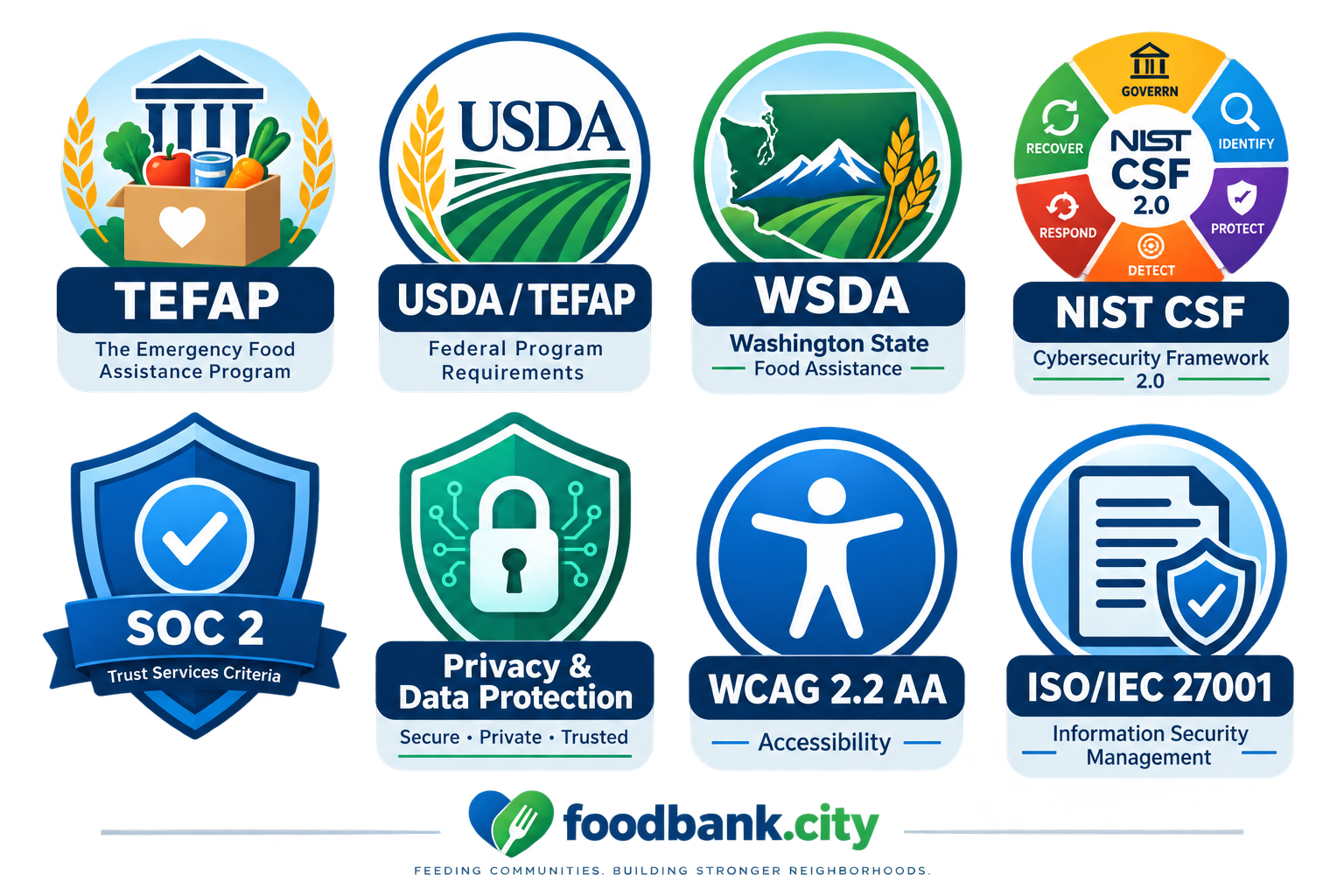
Discover why food banks using Food Bank City’s compliance module outperform others by meeting FEFAP, WSDA, and ISO 27001 standards with ease.
Introduction
Food banks today face increasing regulatory and operational challenges as they strive to serve vulnerable populations efficiently and safely. Compliance with programs such as the Food Emergency Food Assistance Program (FEFAP), the Washington State Department of Agriculture (WSDA) requirements, and international standards like ISO 27001 for information security is critical. Food banks using Food Bank City with its integrated compliance module enjoy a significant advantage in meeting these standards compared to those relying on other management systems.
Understanding the Compliance Landscape for Food Banks
Food banks operate under stringent federal and state regulations to ensure food safety, data protection, and proper funding utilization. Key compliance frameworks include:
- FEFAP (Food Emergency Food Assistance Program): This U.S. Department of Agriculture program mandates strict documentation and inventory controls to ensure that surplus foods are distributed fairly and safely.
- WSDA (Washington State Department of Agriculture): State-level food safety regulations that require detailed tracking and reporting of food handling and distribution.
- ISO 27001: An internationally recognized standard for information security management systems (ISMS), crucial for protecting sensitive beneficiary and donor data.
Food banks must demonstrate compliance to maintain funding, protect client data, and uphold public trust.
Why Food Bank City’s Compliance Module Sets Food Banks Apart
Many food banks rely on disparate systems or manual processes that complicate compliance efforts. Food Bank City integrates comprehensive compliance tools directly into its platform, offering a unified solution:
1. Automated Compliance Tracking and Reporting
Food Bank City’s compliance module automatically tracks inventory movements, volunteer activities, and distribution records aligned with FEFAP and WSDA requirements. This automation reduces human error and simplifies audit preparation by generating real-time compliance reports.
2. Robust Data Security Aligned with ISO 27001
Food Bank City’s platform is built with security best practices modeled after ISO 27001 standards. This includes encrypted data storage, access controls, and routine security assessments to safeguard sensitive information about donors, volunteers, and clients.
3. Streamlined Audit Readiness
The compliance module consolidates all necessary documentation and logs in one accessible location. Food bank managers can quickly respond to audits or funding reviews without scrambling to gather disparate records, reducing stress and risk of non-compliance.
4. Enhanced Operational Efficiency
By embedding compliance workflows within daily operations, Food Bank City reduces duplicative data entry and manual checks. This allows staff and volunteers to focus more on service delivery rather than paperwork.
Data-Driven Benefits Observed by Food Bank City Users
Food banks using Food Bank City’s compliance module have reported:
- 30% reduction in time spent on compliance reporting
- 40% fewer audit findings related to documentation errors
- Greater confidence in managing sensitive data securely
- Improved funding retention due to consistent regulatory adherence
These benefits translate into a more resilient, trustworthy, and efficient food bank operation.
Conclusion
For food banks navigating complex regulatory environments, Food Bank City’s compliance module offers an indispensable advantage. By ensuring adherence to FEFAP, WSDA, and ISO 27001 standards through automation, security, and streamlined processes, food banks can focus on their core mission of alleviating hunger while maintaining operational excellence and public trust.
Adopting Food Bank City is not just a technological upgrade—it’s a strategic compliance advantage that empowers food banks to serve their communities confidently and sustainably.